





If you are weighing a 3.5kVA inverter against a 5kW or 6kW model, the real question is what your home has to keep running when the grid drops, and for how long. Three things settle it: the appliances that run at the same time, the motors and compressors that have to start mid-outage, and the number of hours the battery has to carry that load.
Quick Answer: For a Nigerian home, choose an inverter that covers your simultaneous loads and motor starts. A 3.5kVA inverter may suit managed essentials, but check its rated watts rather than assuming it delivers 3.5kW. Move to 5kW when the smaller unit cannot meet your needs; consider 6kW when measured demand or planned additions justify the extra output. For pumps and compressors, surge duration matters alongside peak power. A larger inverter does not automatically extend backup time: usable battery energy and average consumption determine runtime, while the battery’s discharge current limits the power it can supply.
Why a 3.5kVA Rating Can’t Be Compared Directly With 5kW or 6kW
kVA, kW and power factor
kVA measures apparent power, the product of the voltage and current an inverter has to supply. kW measures real power, the part your appliances turn into light, cooling or motion. Power factor links the two:
kW = kVA × power factor
A 3.5kVA unit with a 0.8 power factor is good for about 2,800W of real load. Closer to a power factor of 1, it approaches 3,500W. So no single watt figure fits every 3.5kVA inverter sold in Nigeria. Efficiency is a different figure altogether: it describes energy lost between battery and socket, and says nothing about how VA converts to W. A 5kVA inverter is not automatically a 5kW inverter; compare the rated watts and power factor on the datasheet.
Five figures to find on any spec sheet
A useful spec sheet states the continuous rated output in both W and VA, the power factor, the surge power and how long that surge can be held. It also gives the battery voltage and the current limits the inverter expects on the battery side. Battery voltage also shapes future upgrades. A 3.5kVA-class inverter often runs on a 24V battery bank, while every 5kW and 6kW model compared below uses a 48V-class battery. Moving up later can mean replacing the battery bank as well as the inverter.
Our closest model to the 3.5kVA class is the GETA-LB-EU 3.6K/24V, rated at 3,600W on a 24V battery system. It suits homes that want to keep a compatible 24V battery bank. Where the inverter must be mounted outside the house, the GEN2-LB-EU 3.6K (3,600W, 48V) is an outdoor-rated IP66 alternative; for a longer service life, mount it away from direct sun and rain. For larger loads, the SNA 3-6K range steps through 3K, 4K, 5K and 6K.
Which Size Fits Your Simultaneous Load and Starting Demand?
Build one load list for all three options
Write down only the appliances that have to run together during an outage. Use measured figures where you have them; otherwise take the input rating from each appliance label.
Sorting that list makes the next steps easier. Lighting, fans, the router and a fridge are the essentials that stay on, while a washing machine or pressing iron can wait for the grid or the sun. Pumps, freezers and air conditioners belong in a group of their own, since their motors and compressors create the starting spikes covered below. Anything you plan to add in the next few years goes on the list as well, so the inverter is sized for where the house is heading. Running all three sizes against this one list keeps the comparison fair. Homes or businesses that may require three-phase power need a broader sizing route; our guide to choosing the right inverter size covers phase selection and larger systems. This comparison stays with 3.5kVA-class, 5kW and 6kW single-phase home options.
Check the starting moment as well as the running total
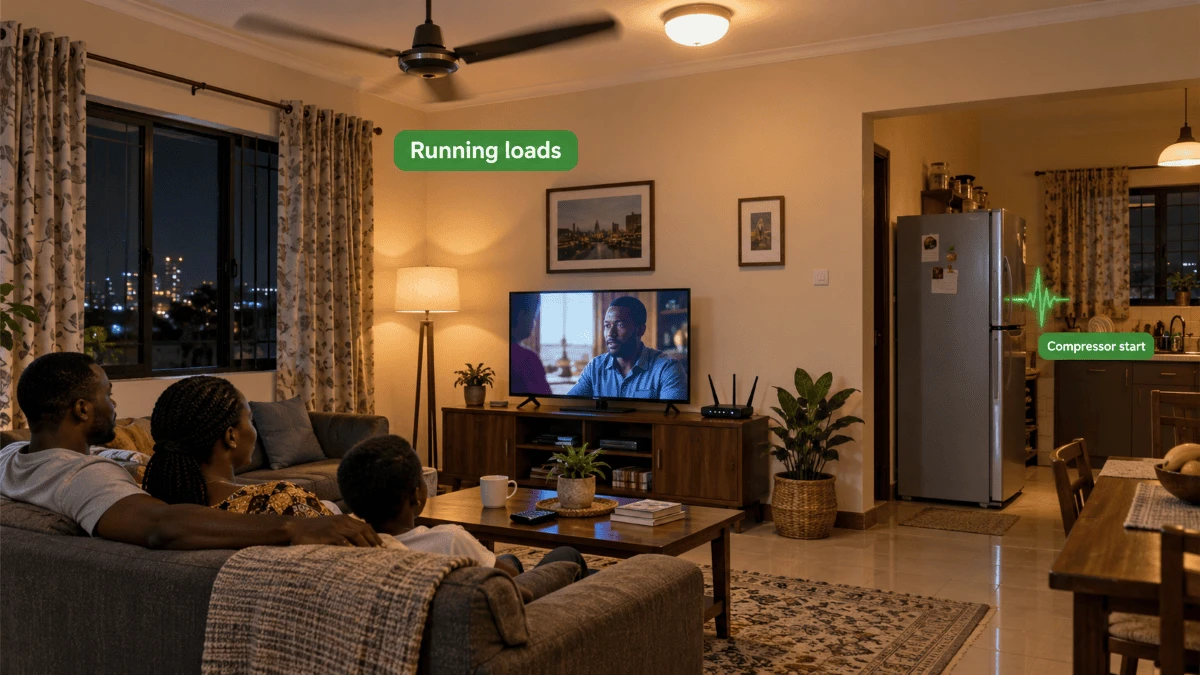
The tightest moment comes when a motor starts while everything else is already on. The sum that counts is the load already running plus the starting demand of the appliance switching on. That motor’s running power isn’t counted twice, and no single surge multiplier fits every fridge, pump or air conditioner, so a label or clamp-meter reading beats a rule of thumb.
Say 1,200W is already running when a pump draws 2,400W to start. For that moment the inverter has to cover 3,600W, and the length of the spike matters as much as its height. GEN2 3.6K is rated at twice its continuous output for 0.5 seconds. The SNA datasheet dated 3 July 2026 specifies surge output of twice the rated power for less than 5 seconds on both the SNA 5K and SNA 6K. A pump that takes one or two seconds to reach operating speed may outlast a 0.5-second surge window.
|
Size |
Best fit |
When to move up |
Main risk |
|---|---|---|---|
|
3.5kVA class (e.g. GETA-LB-EU 3.6K/24V) |
Managed essential-load circuits |
Real watt output or surge capacity falls short of your list |
Tripping when a motor starts on top of the base load |
|
5kW |
Higher simultaneous demand with a few heavier loads |
Load approaches 5kW, or planned additions are already on paper |
Adding inverter power without enough battery power behind it |
|
6kW |
Higher measured demand, more starting headroom or planned expansion |
Selected loads genuinely use the extra 1kW |
Paying for capacity the battery or load profile can’t use |
Moving from 5,000W to 6,000W adds 20% rated output; backup time still depends on the battery.
Why a Bigger Inverter Doesn’t Give You Longer Backup
Power, energy and battery current
Three numbers are at work here. kW sets what can run at once, and kWh sets roughly how long those loads can run. Battery current sets how much power the battery can deliver continuously. Make sure the quote states this limit as well as the battery’s nominal capacity.
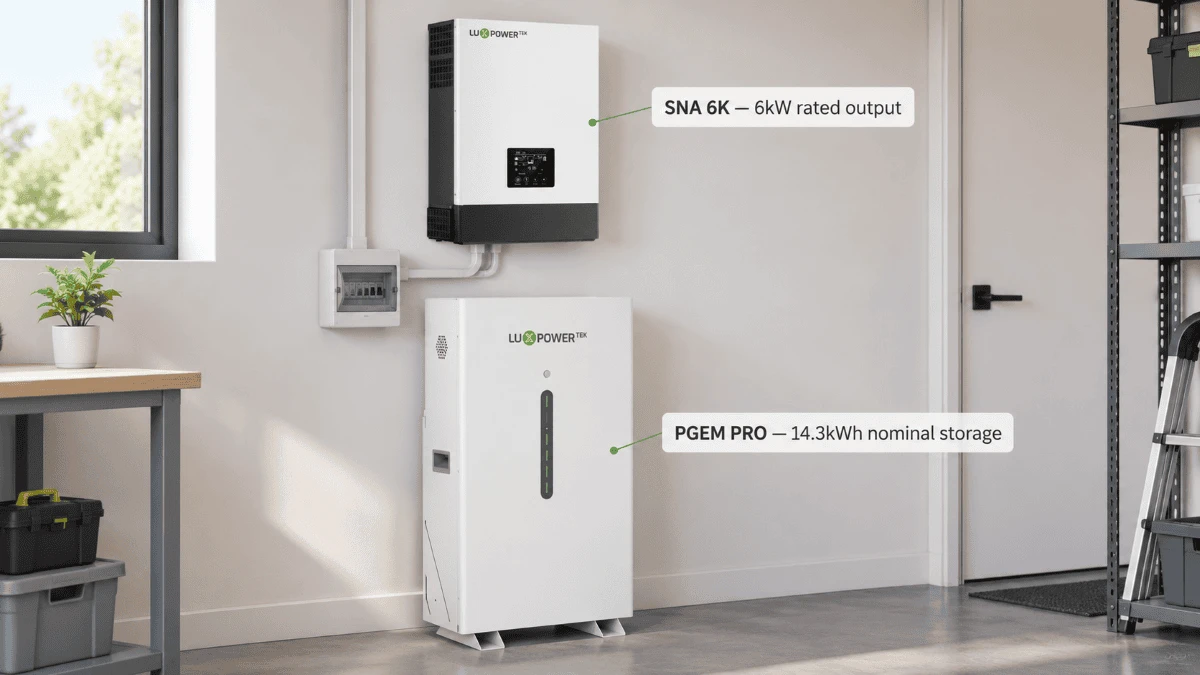
Take PGEM, a 5.12kWh, 51.2V, 100Ah lithium iron phosphate battery with a 100A maximum continuous charge/discharge current. At its nominal voltage, 100A works out to about 5.1kW on the DC side, before inverter losses. SNA 6K, by comparison, is rated for up to 140A of battery discharge. A single PGEM shouldn’t automatically be assumed to support the full 6kW AC output, since available battery power is also shaped by operating voltage, current limits, inverter settings and communication with the battery management system (BMS), the electronics that protect the cells and report their status to the inverter. PGEM PRO stores 14.3kWh at 51.2V and 280Ah, with a 140A maximum continuous charge/discharge current that lines up with SNA 6K’s battery rating. The Eco Beast 6000 specifications reinforce the same point: each 5.12kWh module is rated at 100A, so one module should not be assumed to deliver the full 6kW AC output.
Estimating backup time
Estimated runtime (h) = usable battery energy (kWh) ÷ average load (kW)
In our PGEM sizing example, 5.12kWh × 90% usable depth × 90% efficiency gives about 4.15kWh at the AC side, or roughly 4.1 hours at a steady 1kW. Applying the same illustrative 90% depth-of-discharge and 90% efficiency assumptions to one PGEM PRO gives about 11.6kWh of usable AC energy. Both are estimates rather than guaranteed runtimes, since reserve settings, inverter losses, heat, battery age and shifting demand all move real results.
Where solar input fits
Solar specs mark the design boundaries. SNA 5K accepts up to 8,000W of PV and SNA 6K up to 9,600W, split across two MPPT inputs, the trackers that hold each panel string at its most productive operating point. The MPPT operating range is 120V to 385V, with a maximum input current of 17A per MPPT. Those figures govern how strings can be built, though they say nothing about daily solar production or how many panels to buy; that comes from the chosen module and the recharge the household needs each day.
How 3.6kW, 5kW and 6kW Models Compare in Practice
Our SNA 3-6K range is designed for off-grid or weak-grid backup, while GEN2-LB-EU 3-6K is the hybrid option for homes that coordinate grid, solar and battery operation.
GETA-LB-EU 3.6K/24V: our 3.5kVA-class option
The GETA-LB-EU 3.6K/24V is rated at 3,600W on a nominal 24V battery system, with a maximum PV input of 4,000W, maximum charge currents of 100A from AC and 120A from PV or PV plus AC, a maximum battery discharge current of 140A and a surge rating of twice the rated output for 2 seconds. It is not a 3.5kVA model, but it is our closest option for readers comparing that market class. At full output on battery alone, it draws about 3,600 ÷ (25.6 × 0.90) ≈ 156A, so the battery’s continuous discharge rating must be checked as carefully as its capacity. Readers who need an IP66 enclosure or plan to move to a 48V system can consider the GEN2-LB-EU 3.6K instead.
SNA 5K and SNA 6K with separate batteries
|
Specification |
SNA 5K |
SNA 6K |
|---|---|---|
|
Rated AC output |
5,000W |
6,000W |
|
Maximum PV input |
8,000W |
9,600W |
|
Maximum battery charge/discharge current |
110A/110A |
140A/140A |
Both SNA models use a 48V-class battery system and can integrate a compatible generator alongside solar and grid. The IP20 enclosure needs a dry, ventilated indoor location. The inverter warranty is 2 years, extended to 3 years when paired with LuxpowerTek batteries.
GEN2 5K and 6K for homes that lean on the grid
GEN2 is designed for homes that use grid, solar and battery power together. It has a 7ms UPS switching time, an IP66 enclosure, an operating range of -25°C to 60°C and a five-year standard warranty. Scheduled charging and discharging allow the installer to set charging windows around the household’s usual grid-supply pattern and reserve battery energy for outages. Its surge and battery-current figures differ from SNA’s, so each range is best judged on its own numbers.
Eco Beast 6000: inverter and storage in one cabinet
Eco Beast 6000 pairs a 6kW inverter with one to three 5.12kWh Battery Beast-5 modules, for 5.12, 10.24 or 15.36kWh of nominal storage. Adding modules extends storage while output stays at 6kW.
What Two Installations in Lagos and Port Harcourt Show
Two residential systems from our installation records, both completed in August 2025, use the same inverter in very different ways.
|
Installation |
Inverter |
Battery |
Recorded PV |
|---|---|---|---|
|
Port Harcourt |
One SNA 6K |
One PGEM, 5.12kWh |
Not recorded |
|
Ajao Estate, Lagos |
One SNA 6K |
One PGEM PRO, 14.3kWh |
Twelve 575W panels, 6.9kWp |
Stored energy differs by almost three times, and only the Lagos record lists a solar array. Inverter output, stored energy and solar recharge are separate design decisions, so one 6kW unit can anchor quite different systems. In the Ajao Estate build, the battery’s 140A rating matches the inverter’s battery limit, and the 6.9kWp array sits well inside the 9,600W PV allowance. Neither record includes measured runtime, generation or savings; they show configuration, nothing more.
What to Include in Your Load List and Quote Request
A quote is only as useful as the information behind it. Each detail a homeowner sends has a counterpart the installer’s quote ought to spell out.
|
What the homeowner sends |
What the quote spells out |
|---|---|
|
Loads that run together, with motor and compressor labels |
Exact inverter model and hardware revision, continuous W and VA output, surge power and duration |
|
Target backup hours |
Battery kWh, voltage, BMS protocol and current limits |
|
Existing panels or available roof space |
PV array size, MPPT voltage and current limits |
|
Any inverter, battery or generator already on site |
Compatibility of reused equipment and the generator interface |
|
City, state and single- or three-phase supply |
Cabling, earthing, isolation and protection |
|
Installation location |
Indoor or outdoor placement requirements |
|
Loads planned for the future |
Parallel inverter or battery expansion path |
Itemised pricing for the inverter, battery, PV, monitoring, delivery and labour makes two quotes comparable; a bundled figure hides where the money goes.
To request a load-based inverter recommendation, send the load list and backup target to our teams in Lagos, Abuja and Port Harcourt. For a rough figure first, try our inverter and battery sizing calculator.
Frequently Asked Questions
How much does a 3.5kVA, 5kW or 6kW inverter system cost in Nigeria?
Our 2026 solar inverter price guide records public seller listings checked on 11 September 2026: about ₦595,000 on Jiji for an SNA5000 WPV 5kW/48V, the same 5kW model referred to in this article as SNA 5K, and about ₦650,000 on Solar Village for an SNA 6K. Both prices were for the inverter only. They are seller-market references, not fixed LuxpowerTek prices or complete installed-system quotes. Before buying, confirm the exact hardware revision, stock status, warranty and package scope; batteries, panels, protection, delivery and installation are additional unless stated.
Can a 3.5kVA inverter run an air conditioner?
Sometimes. The air conditioner’s running demand, plus other simultaneous loads, must stay within the inverter’s continuous output and the battery’s available power. Its compressor start must also fit the inverter’s surge rating and duration; starting successfully does not mean the system can sustain the load.
Can a 5kVA inverter run a 1.5HP air conditioner and a borehole pump together?
Not from the 5kVA label alone. Their combined running demand, other simultaneous loads and the battery’s available power must fit within the continuous W and VA limits; any overlapping startup demand must also stay within the inverter’s surge rating and duration.
How many batteries does a 3.5kVA inverter need?
For the GETA-LB-EU 3.6K/24V, one compatible Li-7.5e (25.6V, 300Ah, about 7.68kWh nominal) provides roughly 6.2kWh at the AC side, or about 6.2 hours at a steady 1kW load, assuming a full charge, 90% depth of discharge and 90% conversion efficiency.
How many solar panels does a 3.5kVA inverter need?
Panel count comes from the module chosen, the string voltage window, MPPT current limits, the inverter’s maximum PV input and the household’s daily recharge target. The solar panel sizing calculator turns those inputs into a starting array size.
Choosing the Right Size for Your Home
A 3.5kVA-class inverter can cover controlled essentials, while 5kW or 6kW becomes the better fit as measured demand and motor loads grow. Whichever size the load list points to, the battery’s energy and current, together with the solar array, decide how well that inverter performs once the grid goes off.

 Download