



Quick Answer: Pure sine wave is generally the preferred choice for Nigerian homes and businesses running inverter air conditioners, refrigerators, pumps, computers or other equipment with motors and electronic controls. Modified sine wave may suit a limited set of simple loads when the equipment manufacturer confirms compatibility. Waveform choice does not replace checks for continuous output, surge capacity, transfer time and battery capability.
For Nigerian homes and small businesses managing outages or an unstable grid, waveform choice matters most when refrigeration, pumps and computers share one backup circuit. At LuxpowerTek Nigeria, we recommend pure sine wave for these mixed loads because its smooth AC output is closer to the supply the appliances are designed to use. Modified sine wave remains an option for a limited set of equipment whose manufacturers accept that output.
Start with the appliances that must keep working during an outage. A few compatible basic loads present a different case from a freezer, office workstation and fan sharing one backup circuit. Pure sine wave offers broader compatibility, but the system still needs enough running power, enough surge capacity for motors starting and a battery that can keep up.
How Pure and Modified Sine Wave Inverters Differ
Both types convert battery DC into AC. Pure sine wave rises and falls smoothly through each cycle, while modified sine wave moves through a series of steps. Those steps create more harmonic distortion (electrical “noise”) that can make some motors run hotter or interfere with electronic controls.
Identical voltage and frequency labels can hide that difference. Two inverters may both supply the nominal AC voltage an appliance requires, while producing different shapes through each cycle. The waveform tells you something the voltage label cannot.
Pure vs Modified Sine Wave: Side-by-Side Comparison
|
Feature |
Pure sine wave |
Modified sine wave |
|---|---|---|
|
Output shape |
Smooth, continuously changing voltage |
Stepped approximation of a sine wave |
|
Motors and compressors |
Better suited to mains-powered motors and compressors |
Additional heating or noise possible in some motors |
|
Electronic equipment |
Broad compatibility with grid-designed equipment |
Some power supplies and controls may malfunction |
|
Purchase cost |
Often higher for comparable equipment |
Can be lower for limited-purpose use |
|
Practical fit |
Mixed household and small-business loads |
Specific equipment with established compatibility |
|
Typical examples |
Refrigerators, freezers, pumps, computers, POS terminals and TVs |
Incandescent lighting or basic heating elements where the manufacturer permits modified sine wave |
Voltage, frequency, output power and appliance requirements still apply to either type. A pure sine wave label does not make an undersized inverter suitable for every connected device. Where published, THD (total harmonic distortion) measures how far the output departs from an ideal sine wave and provides a more precise comparison than the category name alone.
Which Waveform Fits the Appliances You Need to Run?
Refrigerators, Freezers, Pumps and Air Conditioners
Refrigeration and water supply deserve particular attention in a backup plan. Modified sine wave can add heating and audible noise in some motors. Pure sine wave is the preferred starting point because it more closely matches the intended AC supply. Electronic controls also matter: an inverter refrigerator’s or air conditioner’s controller may respond poorly to a stepped input even when the motor appears to run. Check the whole appliance, not just the motor.
Starting power is a separate issue. Many compressors and pump motors draw more power while starting than during steady operation. A refrigerator’s running wattage therefore gives only part of the picture. The inverter needs enough continuous output for appliances already running, plus sufficient surge capacity for the next motor start. Surge duration matters alongside the peak rating.
A freezer restarting while a pump is operating creates a different demand from either appliance running alone. For an air conditioner, assess the compressor, fan and electronic controls as one appliance. Use the running input and starting or maximum input on the appliance nameplate or in the manufacturer’s documentation instead of applying one assumed multiplier to every refrigerator, pump or air conditioner.
Computers, POS Terminals and Office Equipment
Electronic equipment brings a different compatibility question. Some active-PFC (active power factor correction) power supplies, common in desktop computers and other higher-power electronics, can have difficulties with stepped backup waveforms. That does not mean every computer requires pure sine wave or that every small charger accepts modified sine wave.
For an office or shop, include the computer, router, POS terminal and printer in the load assessment. Their wattage describes demand; their power-supply requirements establish compatibility. A device working normally on grid power has only demonstrated operation on that supply. Its behaviour during battery operation is the relevant test for backup use.
Pure sine wave makes sense where several electronic devices share one circuit, particularly when equipment will change over time. Keeping a workstation powered through the actual changeover also involves the inverter’s transfer time and the computer’s power supply.
Lighting and Simple Resistive Loads
An incandescent bulb or basic heating element without electronic controls is less sensitive to waveform shape. A correctly sized modified sine wave inverter can be adequate when the equipment manufacturer accepts that supply.
LED lighting, dimmers and chargers need a closer look at their electronics. Likewise, a fan belongs with motor loads, even when it has a simple switch. “Basic appliances” is too broad a description to establish compatibility. Heating elements also draw real power: tolerance of a stepped waveform does not make them economical battery loads.
Is Pure Sine Wave Worth the Extra Cost?
The extra spend is easier to justify when the backup circuit serves refrigeration, computing or a changing mix of appliances. Broader compatibility leaves more room to add equipment without having to reconsider the output waveform each time. A limited setup powering known-compatible loads can still make a lower-cost modified sine wave inverter a reasonable purchase.
When comparing quotations, keep continuous output, surge capability and included components on the same basis. An inverter-only price and a package containing batteries, protection and installation answer different budget questions. Our Nigeria solar inverter price guide separates public hardware references from complete installed-system quotations, which gives buyers a more useful comparison than the waveform label alone.
Compare efficiency at the intended load as a separate question. Maximum efficiency describes one operating point, while standby consumption matters when only lighting and a router remain powered.
A tighter budget can also mean backing up fewer essential circuits with a properly sized pure sine wave system. Keeping the fridge and office equipment supplied may be more valuable than extending backup to every appliance in the building.
What Else Affects Your Backup Power?
Once the waveform suits your appliances, the remaining questions concern the complete system: available output, battery power delivery and transfer time.
Available Output After Sunset
Our GETA-LB-EU 2.5K/12V illustrates why operating mode matters: it supplies 1.5kW on battery alone and 2.5kW with PV plus battery. A 2kW evening load would exceed its battery-only rating even though the model name includes 2.5K. Its sine-wave output does not remove that power limit. This 12V GETA example is separate from the 48V-class SNA and PGEM system discussed below; the battery platforms are not interchangeable.
Waveform Quality and Changeover Time
For the following 48V-class example, our SNA 3-6K range uses a nominal 48V battery system. The 3 July 2026 datasheet lists sine-wave output and THDV at 3%. Lower THDV indicates less distortion from an ideal sine wave.
Transfer time answers another question: how quickly supply changes during a power interruption. The datasheet also specifies switching below 7ms for a single inverter and below 20ms in parallel operation. Those configurations have different limits, so the single-unit figure cannot describe every installation.
A transfer-time rating alone cannot guarantee that every computer stays running. The connected power supply and operating load also affect the result. A changeover test with the actual workstation establishes whether separate UPS protection is needed for uninterrupted work.
Battery Power in a 48V-Class SNA System
On the 48V-class SNA platform, our PGEM battery shows why stored energy and discharge power need separate checks. Its 5.12kWh rating describes nominal stored energy, while its maximum continuous discharge current is 100A at a rated voltage of 51.2V. At nominal voltage, 51.2V × 100A equals 5.12kW on the DC side before conversion losses.
A single PGEM module therefore cannot be assumed to sustain the full 6kW AC output of an SNA 6K on battery alone. The battery’s continuous current limit can restrict output before its stored energy is exhausted.
Energy capacity helps estimate how long a load can run; the discharge limit determines how much power is available at once. A motor start may briefly demand more current than steady operation, so both battery and inverter limits matter when assessing a pump or compressor.
From Waveform Choice to a Working System in Nigeria
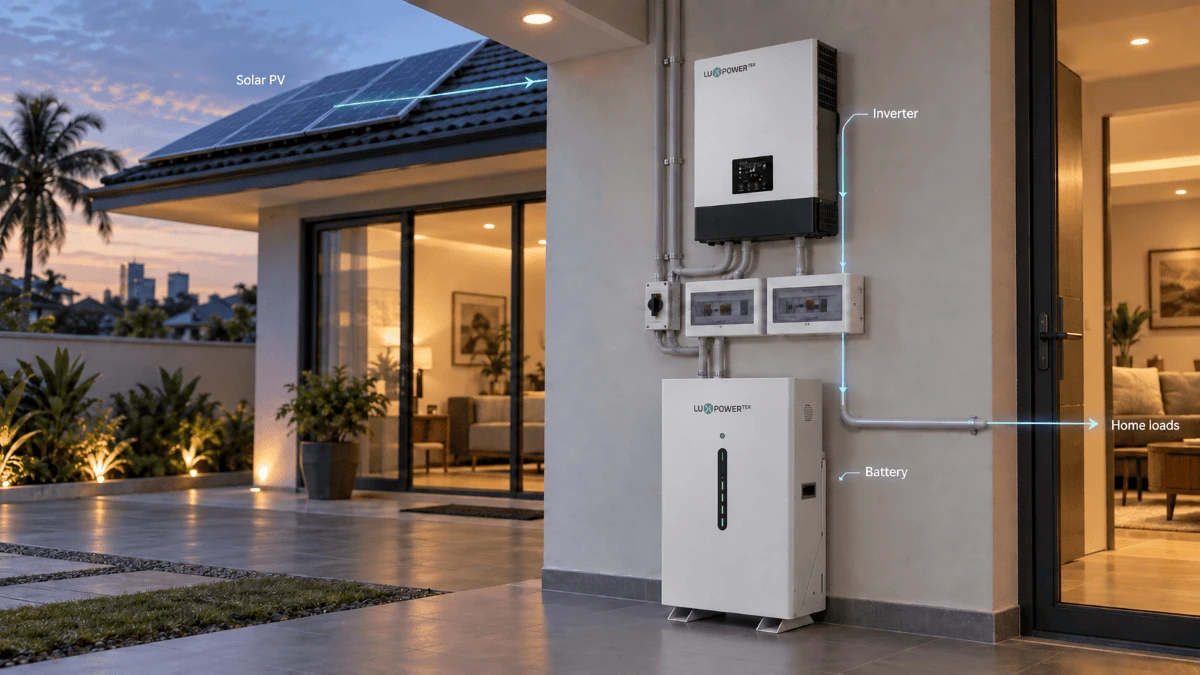
Our installation at Ajao Estate, Lagos combines one SNA 6K inverter, one PGEM PRO 14.3kWh battery and twelve 575W solar panels. The array totals 6.9kWp of nameplate capacity.
Compared with a single PGEM module, PGEM PRO provides a larger nominal energy reserve, but the SNA 6K’s continuous output remains 6kW. The reserve still needs to match the appliances used after sunset. Likewise, 6.9kWp describes the installed array rather than its daily energy yield, which depends on sunlight, installation conditions and daytime consumption.
One night in September showed what that reserve covers in practice. Rain had come and gone through the afternoon, but the battery was full by early evening when grid supply across Ajao Estate dropped shortly after 7pm. Neighbours’ generators started within minutes; this house stayed quiet. The family watched the evening news and a film until about 11pm, the Wi-Fi router stayed on through the night, and ceiling fans ran in three rooms. The inverter fridge and a chest freezer holding a week’s meat, fish and soup cycled normally, with no buzzing from either compressor. As the TV went off, the 1HP inverter air conditioner in the main bedroom came on and ran until about 5am.
Just before 6am, the surface pump ran for about 20 minutes to fill the overhead tank, and the inverter took the motor start without tripping. Grid supply had still not returned by breakfast. The monitoring app showed the battery had delivered about 8kWh overnight, including roughly 3kWh to the air conditioner and 1.7kWh to the fans, and still held about 43% as the panels began picking up the morning sun.
The household’s generator was never needed that night. SNA can also accept compatible generator input for supply and charging; automatic starting depends on the generator interface, control wiring and settings. That capability is separate from waveform quality. The appliances still need a suitable AC waveform, while the load profile and available energy determine how long they can run.
Frequently Asked Questions
Do Inverter ACs and Fridges Need Pure Sine Wave?
Pure sine wave is generally recommended for inverter air conditioners and refrigerators because they combine compressors with electronic controls designed for grid-like AC. Check the appliance documentation and size the inverter for both running and starting demand; waveform compatibility alone does not establish sufficient power or runtime.
Can a Modified Sine Wave Inverter Damage Appliances?
Damage is possible with incompatible equipment. Some motors, electronic controls and particular charger designs can overheat or malfunction on a stepped supply. Unusual buzzing, excess heat or erratic operation calls for stopping use and checking the equipment’s supply requirements. A device simply switching on does not establish long-term suitability.
Will Pure Sine Wave Make the Battery Run Longer?
Not by itself. Runtime depends mainly on usable battery energy, appliance power, operating hours, reserve settings, temperature and the inverter’s efficiency at the intended load. A fixed runtime improvement cannot be inferred from waveform type alone.
Can an Existing Battery Be Reused?
Reuse is possible when the battery voltage, discharge capability and charging configuration match the inverter. For lithium batteries, confirm the supported charging settings and any battery-management communication requirements. The GETA family includes separate 12V, 24V and 48V models, so the full model designation matters. Send a clear photo of the battery label to our team on WhatsApp for a compatibility check.
Choosing the Right Waveform and System
Choose pure sine wave when refrigeration, motors and electronic equipment share the backup supply. Modified sine wave retains a narrower role where appliance compatibility is already established and the application remains limited.
Send your appliance list, location, target backup hours, existing battery model and any pump or compressor starting data through the LuxpowerTek Nigeria contact form. Our technical team can then prepare a system-sizing quote based on the equipment that must operate together.

 Download